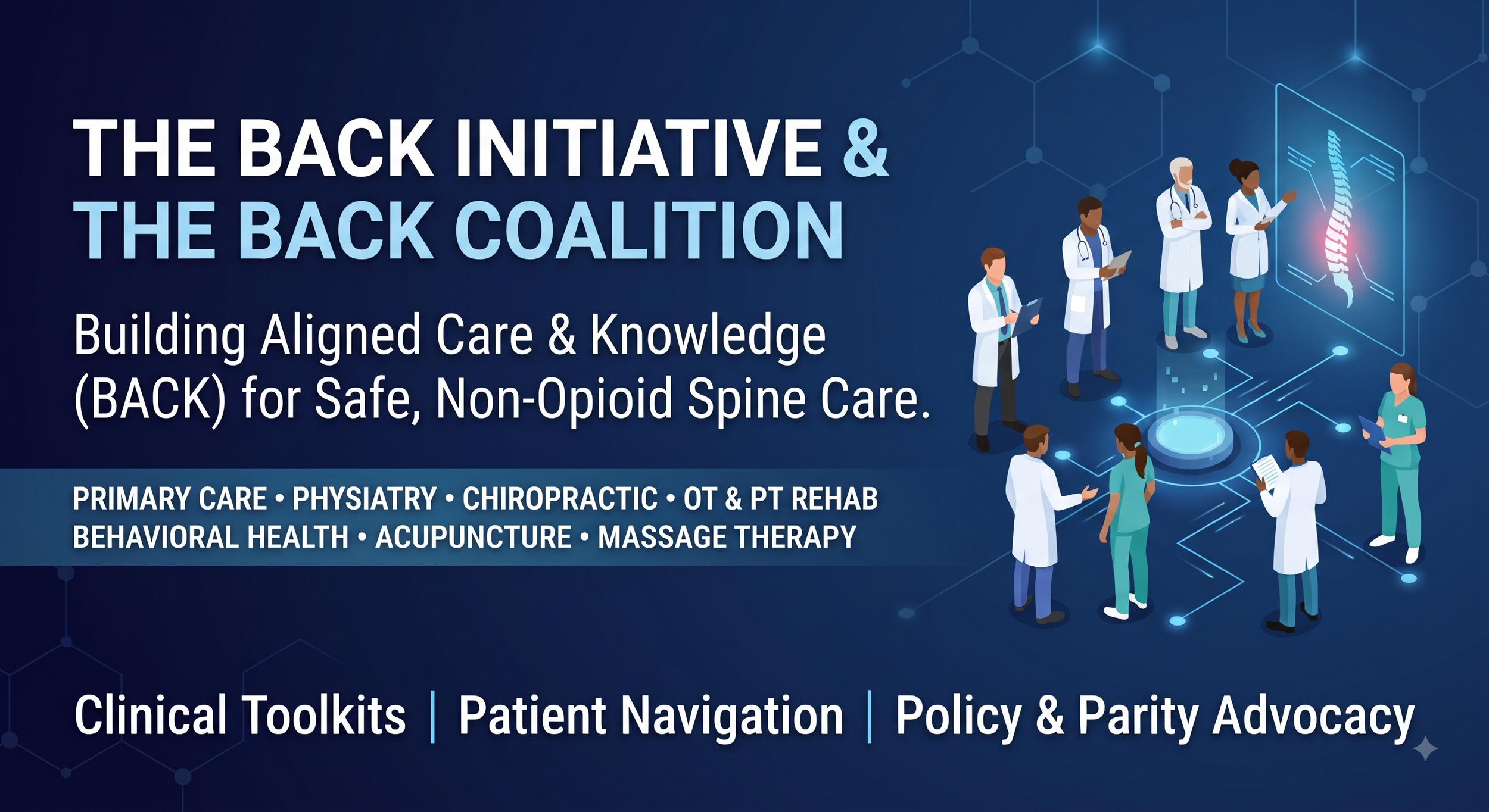
Our Mission
We make sure no one has to wait for care or rely on opioids for back pain. By connecting doctors, therapists, and specialists, we build simple referral systems, offer free tools, and fight for rules that put patients first.

Our Services
What We Do
Connect Doctors and Specialists: We bring together primary care doctors, chiropractors, physical and occupational therapists, mental health experts, and other specialists so your healthcare team can easily talk to each other.
Provide Free Tools and Guides: We share simple, research-supported guides online to help patients understand their treatment choices. We also give clinic teams simple tools to streamline referrals. All online resources are free.
Fight for Fair Health Rules: We work to change healthcare policies so insurance companies cover safe, non-opioid treatments for back and neck pain.

This comprehensive 4-page briefing document integrates the clinical and economic foundations of The BACK Initiative with model legislation, state vocational rehabilitation frameworks, and a multi-stakeholder advocacy strategy.
Part 1: State Legislative & Policy Frameworks
The Fiscal Challenge: Outlines how musculoskeletal (MSK) pain drives state budget deficits through low-value care escalations (early MRIs, ER visits, and premature surgeries).
Fiscal & Outcomes Matrix: Demonstrates how early conservative care cuts long-term opioid use by up to 89% and lowers 12-month total cost of care.
Part 2: Model State Legislative Draft
Full Ready-to-Draft Bill Language: Entitled the "Non-Pharmacologic Pain Care Access and Cost Containment Act."
Part 3: Vocational Rehabilitation & State Work Restoration Integration
Title I Rehabilitation Act Alignment: Leverages federal/state VR funding streams (such as Arkansas Rehabilitation Services — ARS — and equivalent state agencies nationwide) for "Physical & Mental Restoration Services."
Work Rehabilitation Modalities:
Functional Capacity Evaluations (FCEs): Objective testing by OTs/PTs to measure safe physical lifting limits and tolerances.
Work Conditioning / Work Hardening: Goal-oriented physical restoration programs to prepare injured workers for job demand categories.
Ergonomic Workstation Assessments: On-site task analysis by OTs to adjust seating, desk height, and body mechanics to prevent re-injury.
Interprofessional VR Case Management Workflow: 3-step pathway linking treating clinicians with State VR Counselors and Business Engagement Representatives.
Part 4: Building Advocacy Coalitions & Implementation Action Plan
Stakeholder Coalition Mapping: Actionable coalition strategies bringing together:
Clinical Associations: Unifying State OT, PT, Chiropractic, and Medical societies under a joint coalition.
Employers & Payers: Demonstrating reduced workers' compensation claims and disability payouts to self-insureds and public employee trust funds.
Patient & Worker Advocates: Protecting patient rights to non-drug care options without financial penalties.
12-Month Implementation Roadmap: Phased milestones covering coalition formation, legislative committee introduction, administrative rulemaking, and VR agency integration.

This four-page Clinical Provider Toolkit from The BACK Initiative serves as a standardized, interprofessional framework designed to streamline non-pharmacologic spine and pain care across primary care, chiropractic, occupational and physical therapy, acupuncture, and pain psychology.
Part 1 — Referral & Order Form: CMS-1500 & Medicare/Medicaid compliant order form for MDs, DOs, NPs, and PAs ordering conservative therapies.
Part 2 — Triage & Care Integration Workflow: Discipline-specific referral criteria (OT, PT, Chiropractic, Acupuncture, CBT) and 14-day early care standards.
Part 3 — Communication Scripts & Practice Guidelines: Verbatim patient dialogue scripts addressing early imaging deferral and non-drug options.
Part 4 — Primary Care EHR SmartPhrase Template (.BACKINITIATIVE): Standardized EHR text macro for medical providers to document functional baselines, non-pharmacologic orders, and required 30-day Medicare Plan of Care (POC) certifications.

Accessible 2-Page Patient Education & Self-Advocacy Handout
A warm, clear, and easy-to-read guide designed to reassure patients experiencing back or neck pain and empower their family members. Written at a 5th-grade reading level with high-contrast formatting and large font for effortless reading during intake or consultation.
What’s Included in the 2-Page Guide:
Part 1: Simple Steps to Heal & Care Team Breakdown
Clear, actionable recovery steps (gentle movement, heat/ice, deep breathing).
Simple explanations of what Chiropractors (DCs), Occupational Therapists (OTs), and Physical Therapists (PTs) do to help without surgery.
Part 2: De-Bunking Imaging Myths, Glossary & Patient Rights
Imaging Guidance: Explains why early X-rays and MRIs are rarely needed and normalizes age-related "wrinkles on the inside".
Plain-Language Glossary: Defines confusing terms like Conservative Care, Segmental Dysfunction, and Ergonomics.
Rights & Funding: Informs patients of their right to non-drug options, explains insurance coverage (Medicare/Medicaid), and provides advice on clinic financial assistance.
Key Features:
Format: Printable 2-page Letter PDF.
Accessibility: 13pt+ font, generous whitespace, high-contrast text, and 5th-grade reading level.
Audience: Primary care waiting rooms, chiropractic clinics, rehabilitation practices, and community health programs.
Follow Our Latest Insights